Ask any grower what slows harvest down and you’ll rarely hear “the combine.” More often it’s everything around it. The grain cart has to be in the right place at the right time, the trucks have to keep moving, and every one of those machines needs someone in the seat. When you’re one driver short, the whole operation runs at the speed of the gap. The same goes for tillage after harvest, when there’s a narrow window to get the ground ready and only so many people to run the tractors.
The labor shortage isn’t new, and it isn’t going away. What’s changing is how growers can answer it.
What OutRun does
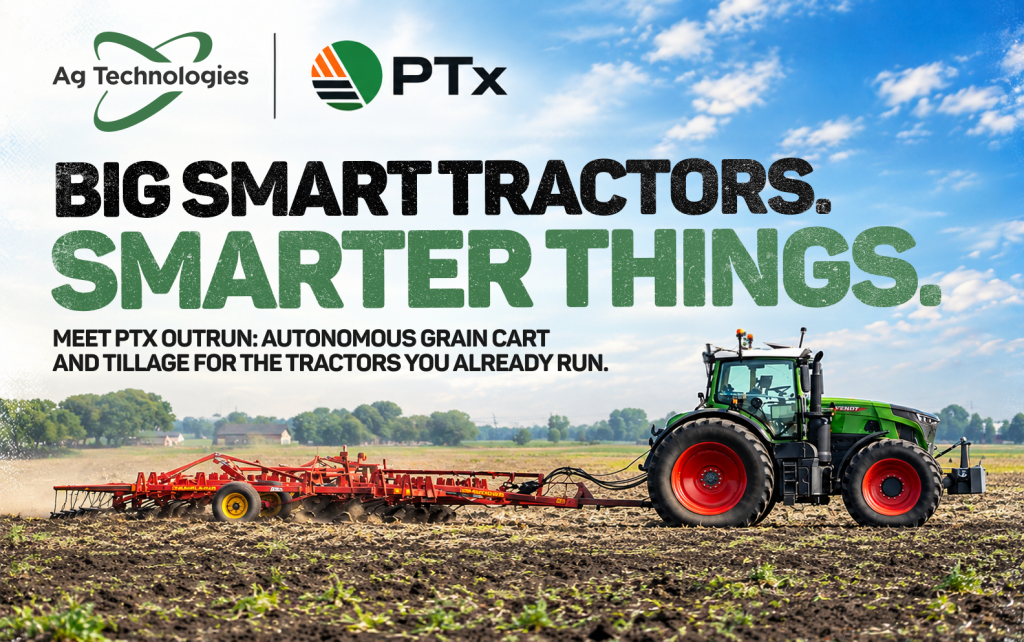
PTx OutRun is a retrofit autonomy system from PTx Trimble. Instead of asking you to buy a new autonomous machine, it adds autonomy to high-horsepower tractors you’re already running. Today it supports two jobs. The first is the grain cart: the combine operator can stage the cart or call it in for unloading, then send it to a set unload zone by the trucks, with no second driver in the tractor. The second is tillage. Pair an OutRun tractor with your tillage tool and it becomes an autonomous tillage package, freeing your people for other work during one of the busiest stretches of the year.
The system is built for mixed fleets, so it isn’t tied to one brand of implement. It currently works with John Deere 8R and 8000R tractors with IVT transmissions, and PTx has said Fendt 900 and 1000 Series support is on the way. The industry has taken notice, too. OutRun’s grain cart technology won a Davidson Prize in 2025, and OutRun Tillage won one in 2026.
PTx’s own message is about timeliness. As Darcy Cook, senior director of autonomous solutions at PTx, put it, “Timeliness of every field task matters.” When a seat goes empty, timeliness is usually the first thing to slip.
Two paths to autonomy
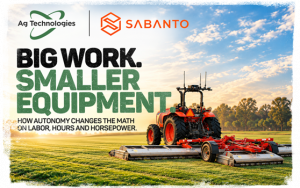
If you’ve followed our posts on Sabanto, you might be wondering how the two fit together. They’re both answers to the labor problem, but they answer different questions. Brian Kelley, President of AgTechnologies, sums it up this way: “One is using small dumb tractors to do smart things, and the other one is big smart tractors to do smarter things.” By “dumb,” he means a tractor with no guidance on it at all. Add Sabanto, and that same tractor becomes smart enough to work on its own.
Sabanto makes the most sense for repetitive work where a smaller tractor can run longer hours, like mowing sod or other high-repetition field jobs. OutRun is built for big-acreage row crop operations where high-horsepower tractors are already on the farm, and where the grain cart and tillage windows are what keep you up at night. Today the two don’t really overlap. “They solve two different problems,” Brian says. Over time, the lines between them will likely blur, and growers will have more ways than ever to put an empty seat back to work.
Finding the right fit
Not every operation needs autonomy tomorrow, and not every tractor is a fit for OutRun today. That’s exactly why the conversation should start with your operation: your acres, your equipment, your harvest logistics and where labor is costing you the most. From there, we can help you figure out whether OutRun, Sabanto or something else entirely makes sense, and what it would take to get there.
If you’re running big acres with a short crew, we’d like to hear what your harvest looks like.
Want to learn more about PTx OutRun? Contact AgTechnologies to talk through your operation.