Now that the heaviest stretch of mowing season is behind us, it’s a fair time for an honest look back. Did you get to every acre when it needed it? Did you hit the windows you wanted, with the help you had? For a lot of the sod growers we talk to, the answer is “not quite.” There were weeks when the crew couldn’t get around fast enough, a field went a few extra days between cuts, and the grass didn’t knit in as quickly as it should have. Nobody did anything wrong. There just weren’t enough hours, or enough people to fill them.
That’s not a sod problem alone. Growers across every crop are being asked to cover the same ground, or more, with fewer hands. And for a long time, the only real answer has been to buy bigger.
The old equation
Brian Kelley, President of AgTechnologies, likes to break it down simply. For years, the math of fieldwork has looked like this: a person, plus a tractor, plus an implement of a certain size, times the hours that person can work, equals your output. That’s how you got to “we covered 200 acres today.”
The catch is that the hours and the person have always been tied together. “You can only get so many hours out of a person in the seat of a tractor,” Brian says. So when growers needed more output, they couldn’t add hours. They added horsepower: a bigger tractor, a wider implement, more acres per hour to squeeze the most out of the hours they had.
Change one part of the equation
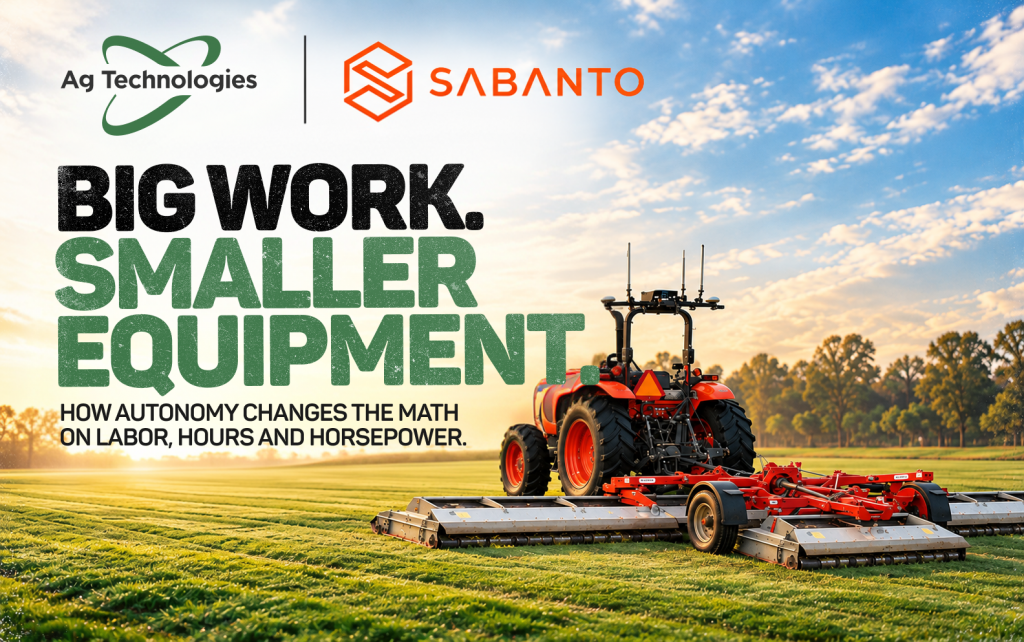
Autonomy changes that math. Take the person out of the seat and the hours are no longer capped by a shift. There are 24 hours in a day, and a machine that doesn’t need a driver can work a lot more of them. Brian puts a realistic number on it at 16 or 17 hours a day.
Once the hours open up, the horsepower question looks different too. “It used to be you had a bigger, higher-horsepower machine to get across more acres faster,” Brian explains. “What if we can have a lower-horsepower machine, run it a little bit longer, get across it a little slower, but still get it done in a day’s time?” A smaller tractor running longer can cover the same ground, often at a very different cost.
That’s the idea behind Sabanto. Rather than selling you a new machine, Sabanto retrofits tractors you may already own and turns them into autonomous workhorses. In sod and turf, that means mowing on the schedule the grass needs instead of the one your labor allows. The same kit can handle other repetitive field jobs like tilling, rolling, aerating and seeding, with GPS guidance, obstacle detection, geofencing and emergency stops built in. Your people don’t go away. They move to the work that actually needs them.
There are smart savings in how growers set it up, too. As Brian has told growers, “We started buying open ROPS machines instead of cab tractors, which instantly knocked $20,000 to $30,000 off the system cost.”
The right tool for the right job
This isn’t an argument against big equipment. Large, high-horsepower tractors still do work nothing else can, and there are jobs where they’re exactly the right call. The point is that growers now have another option. If you find yourself needing to do big work with smaller equipment, a Sabanto-equipped tractor may be worth a serious look.
The impact is different from one farm to the next, and we’ll be the first to say so. What we can tell you is that the growers running Sabanto are the ones telling us the return is real, both in agronomic results and in their bottom line. The best way to know what it could mean for your operation is to start with your operation: your acres, your crew, your equipment, and the windows you’re trying to hit.
If this past season felt like you were always one field behind, let’s talk about what next season could look like.
Want to see whether Sabanto fits your operation? Contact AgTechnologies to talk through your acres or request a demo.